Table Of Content
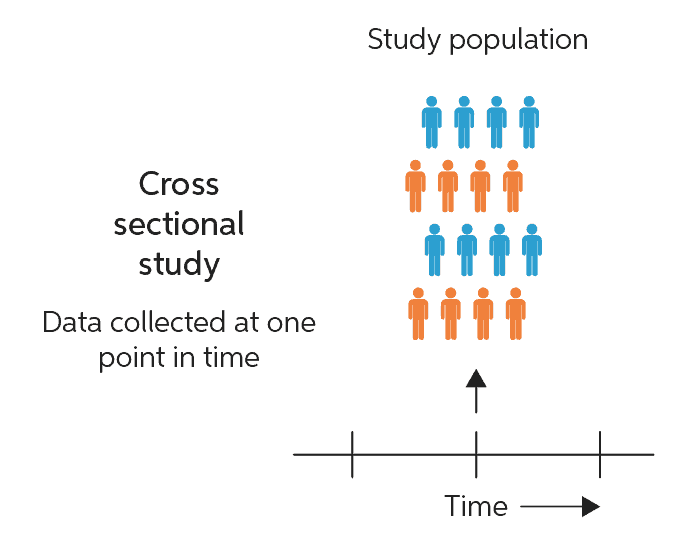
One key difference is that cross-sectional studies measure a specific moment in time, whereas cohort studies follow individuals over extended periods. For example, Anderson et al. conducted a case–control study to look at risk factors for childhood fractures.[3] They recruited cases from a hospital fracture clinic and individually matched controls (children without fractures) from a primary care research network. They found that the history of previous use of vitamin D supplements was significantly higher in the children without fractures, suggesting an inverse association between vitamin D supplementation and incidence of fractures. Conversely, the study also allows comparisons between patients and non-patients, who were exposed to an alleged risk factor5. The main characteristic of cross-sectional studies is that the observation of variables, whether they are cases, individuals, or other types of data, is performed in a single moment (the same), when the researcher records a "photograph" of the facts (variables) of interest and not the "movie" of its evolution1,2.
Descriptive Studies

This paper offers insights into the challenge of resisting voyeurism in mental health research, whilst contributing to recent efforts to draw a post-qualitative research methodology out of Deleuze and Guattari’s work. Our analysis is motivated by a profound rupture, a break in the trajectory of a specific line of qualitative inquiry occasioned by the passionate refusal of a participant in the empirical study that grounds this paper. Borrowing conceptual and analytical tools from Deleuze and Guattari, we focus on the major ethical and methodological implications of this participant’s refusal.
Similar articles
In the EU, the Marie Curie Initial Training Networks provides doctoral candidates with mobility and networking opportunities to enhance research and transversal skills development, joint collaborative research and graduate employability (EC, 2011b). We agree with the idea that internships are a key factor for integration in the work market. Internships allow students to apply the theoretical knowledge acquired in class, to develop and reinforce the professional skills in the workplace and they also offer the possibility of demonstrating their abilities and skills to entrepreneurs.
Low uptake of cervical cancer screening among HIV positive women in Gondar University referral hospital, Northwest ... - BioMed Central
Low uptake of cervical cancer screening among HIV positive women in Gondar University referral hospital, Northwest ....
Posted: Thu, 07 Jun 2018 07:00:00 GMT [source]
How to cite this article
Reviewers consider the quality of the proposed contribution and whether it addresses topics of interest or raises relevant issues in systemic design. Editor’s Choice articles are based on recommendations by the scientific editors of MDPI journals from around the world.Editors select a small number of articles recently published in the journal that they believe will be particularlyinteresting to readers, or important in the respective research area. The aim is to provide a snapshot of some of themost exciting work published in the various research areas of the journal. Feature papers represent the most advanced research with significant potential for high impact in the field. A FeaturePaper should be a substantial original Article that involves several techniques or approaches, provides an outlook forfuture research directions and describes possible research applications.

This study provides relevant ideas for faculty, industry and doctoral students on enhancing the employability of doctoral graduates through the development of transversal skills. Finally, in relation to the implementation of transversal competences in VET models, we would like to highlight that nowadays, countries with well-developed VET systems present lower youth unemployment and policymakers are exploring the possibility to transfer this successful model to their countries. There is a general perception that the key for success lies in the curricula of VET programs and the combination of theoretical knowledge with internships. Nevertheless, we agree with Renold et al. (2018) in stating that the difference is on the level of relationship among all the actors in education and employment systems, emphasizing the need for collaboration among the different stakeholders to adapt these models to the real situation in each country.
Longitudinal vs Transversal Studies
These data would be helpful to a health planner to assess the need for a school eye health program, and to know the proportion of children in her jurisdiction who would need corrective glasses. Finally, the figure below will help you with your understanding of different types of study designs. In these studies, researchers study one group of people who have developed a particular condition and compare them to a sample without the disease. Cohort studies, on the other hand, begin by selecting a population of individuals who are already at risk for a specific disease. Cross-sectional studies can be done much quicker than longitudinal studies and are a good starting point to establish any associations between variables, while longitudinal studies are more timely but are necessary for studying cause and effect. However, cross-sectional studies differ from longitudinal studies in that cross-sectional studies look at a characteristic of a population at a specific point in time, while longitudinal studies involve studying a population over an extended period.
Patterns and predictors of co-morbidities in Tuberculosis: A cross-sectional study in the Philippines Scientific Reports - Nature.com
Patterns and predictors of co-morbidities in Tuberculosis: A cross-sectional study in the Philippines Scientific Reports.
Posted: Thu, 05 Mar 2020 08:00:00 GMT [source]
Observation of teaching behaviour showed that teachers were working in the multifunctional environments required for establishing powerful learning environments and they tried to extend the authenticity of the learning environment. However, there was less variation in activities, learning material and learning contexts, in particular, when students were working and learning in a simulated environment. A global competitive environment, new management processes and new technologies that require employees to show autonomy, problem solving skills and a high degree of flexibility to adapt to the new circumstances and new technologies, characterize it. The current VET students have been in contact with new technologies (smartphones, tablets, video consoles) from an early age, so most of them have previous experience and prefer to use social media apps, text messages and blogs to interact and get information rather than the more traditional methods.
In such cases, analyses are also subject to selection and information bias as well as confounding. Nested case-control design is a special type of case-control study design which is built into a cohort study. From the main cohorts, participants who develop the outcome (irrespective of whether exposed or unexposed) are chosen as cases. From among the remaining study participants who have not developed the outcome, a subset of matched controls are selected. This is still a backward-direction (since the enquiry begins with outcome and then proceeds toward exposure) and retrospective study (since outcomes have already occurred when the study starts). The main advantage is that since one knows that the outcome had not occurred when the cohorts were established, temporal relation of exposure and outcome is ensured.
Implementation of transversal competences in VET models
Based on the maternal serum 25-hydroxy vitamin D levels during pregnancy, children were divided into two groups – those born to mothers with normal blood vitamin D and those born to mothers with low blood vitamin D. The authors found that children born to mothers with low vitamin D levels had persistent bone abnormalities. Cross-sectional studies have their great use in descriptive studies, while used in studies that are proposed to be analytical, the results must be interpreted by researchers with good experience in that specific field of knowledge, using a lot of caution and common sense. In addition to statistical associations, this type of analysis also allows us to calculate the Prevalence Ratio (PR), defining whether and in which group it is higher. Assuming that it was the same, the result of the division (ratio) of the prevalence of the risk group by that of the risk-free group would be "1".
These were the main objectives of a study conducted in Continuing Vocational Education and Training (CVET) in Spain by París, Tejada and Coiduras (2018). Based on the results, three professional profiles were defined (training manager, trainer and mentor) with their respective functions, professional activities and specific and transversal competences. The authors concluded that the delimitation of the occupational profiles prevents professional intrusion, provides guarantees for quality professional work, and establishes levels of qualification, certification and accreditation to recruit competent professionals. This blog introduces prospective and retrospective cohort studies, discussing the advantages, disadvantages and use of these type of study designs. A cohort study is a type of longitudinal study that samples a group of people with a common characteristic.
It studies design as ethics, its role in sustainability (social and environmental), and the nature of agency in design's construction the artificial. According to Baumeler (2019), studies that investigated the transfer of the dual VET model to other countries came to the conclusion that only certain elements might be successfully implemented and the model needed to be adapted to each country. (Euler 2013; Fortwengel and Jackson 2016; Graf et al. 2014; Powell and Fortwengel 2014). Descriptive studies are useful for estimating the burden of disease (e.g., prevalence or incidence) in a population.


No comments:
Post a Comment